In healthcare, prevention is always better than cure. Yet, one of the most common and devastating risks for patients is falls that often go unnoticed until it is too late. Falls are the leading cause of injury among older adults and pose a significant threat to individuals with conditions such as Parkinson’s, Alzheimer’s, multiple sclerosis, or post-stroke complications. These incidents not only cause physical harm but also lead to longer hospital stays, emotional distress for both patients and their families, and reduced quality of life for patients.
Traditional fall-prevention technologies, such as bedside alarms or smartwatches, are helpful; however, they are largely reactive, as they notify caregivers only after the fall has already occurred. The need for a proactive alternative raises a critical question: what if technology predicts a fall before it happens?
This challenge drives the development of Glide’s Fall Prediction and Detection System, a real-time, AI-powered solution that provides early warnings up to 0.3–0.4 seconds before impact. In healthcare, even fractions of a second often determine the difference between successful intervention and life-altering injury.
Healthcare Need: Why Predicting Falls Matters
Every fall has a story: an elderly patient losing balance while standing up, a stroke survivor struggling to coordinate movements, or someone with low blood pressure collapsing without warning. For caregivers, these moments are overwhelming, and while technology like bedside alarms, life alert buttons, or smartwatch notifications exist, they are often reactive, as they notify after the event.
What is missing is a safety net that anticipates falls, reduces uncertainty, and empowers caregivers to respond proactively. Glide’s Fall Prediction and Detection System address this need by combining wearable sensing with computer-vision-based AI.
How the System Works: The Technology Behind the Safety Net
The solution is not based on a single technology; instead, it is a fusion of multiple approaches working together to create a reliable and accurate prediction system. [See Figure 3]
- Sensor-Based Approach
Patients wear a lightweight device embedded with a 9-axis IMU sensor (accelerometer, gyroscope, and magnetometer). This sensor captures micro-movements in real time and streams the data to an edge device. The LSTM-based model on the edge device evaluates the sequence of movements, distinguishing ordinary actions (such as bending to pick an object) from hazardous movement patterns indicative of an impending fall. This framework extends to monitor vital signs, including heart rate, oxygen saturation, and irregular heartbeat—factors that frequently serve as precursors to dizziness, fainting, or collapse. By combining motion data with physiological signals, the system transitions from reactive to predictive care.
- Vision-Based Approach
A camera-based system continuously observes the patient and applies pose-estimation algorithms such as MediaPipe to extract skeletal key points (e.g., shoulder, hip, and knee coordinates). These points are then analyzed by another LSTM model to monitor posture transitions. However, what a human instantly interprets as a fall, collapse, or forward drop appears as pixel changes to an AI model. To address this challenge, the vision-based model is trained to identify subtle and progressive posture changes that characterize fall dynamics.
This module also supports future extensions, such as detecting environmental risk factors—obstacles, slippery floors, wheelchair tilt, or low-visibility areas
- Smart Fusion: Reducing False Alarms
One major challenge in fall prediction is minimizing false alarms. Routine movements, such as sitting quickly or tying shoes, may resemble falls in isolated signals.
To mitigate this challenge, the system fuses outputs from both the sensor and vision models using custom logic. When both streams align, the system confirms the prediction, significantly reducing false positives and ensuring caregivers receive high-fidelity alerts. All output data is displayed through an integrated monitoring dashboard that provides live video streams, real-time alerts, and visual indicators, enabling caregivers to monitor patients seamlessly and act immediately with confidence.
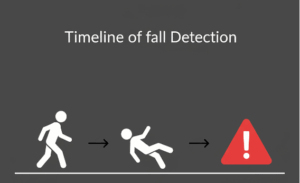
Fig 1. Fall Detection Timeline
System Development and Architecture
The development of the Fall Prediction and Detection System follows a structured engineering process focused on data quality, model reliability, and deployment feasibility. (Removed narrative tone and subjective phrasing.) To identify characteristics associated with the fall events, detailed analysis of motion patterns from K-Fall dataset, indicate that real-world falls present higher variability and complexity. To address these limitations, a custom dataset is made, incorporating fall-prone movements aligned with realistic scenarios. Initial threshold-based approaches provide baseline insights; however, they lack adaptability and fail to generalize across diverse populations. This limitation leads to the design of LSTM-based models suited for sequential motion analysis.

Fig 2. Fall Detection
For the vision-based component, existing public datasets are identified as insufficient, due to low resolution and limited sample diversity. To overcome this constraint, a curated dataset of fall and daily activity video sequences is developed in controlled environments. Training the sensor and vision models in synchronization introduces alignment challenges, requiring both models to maintain synchronized prediction windows without latency drift.
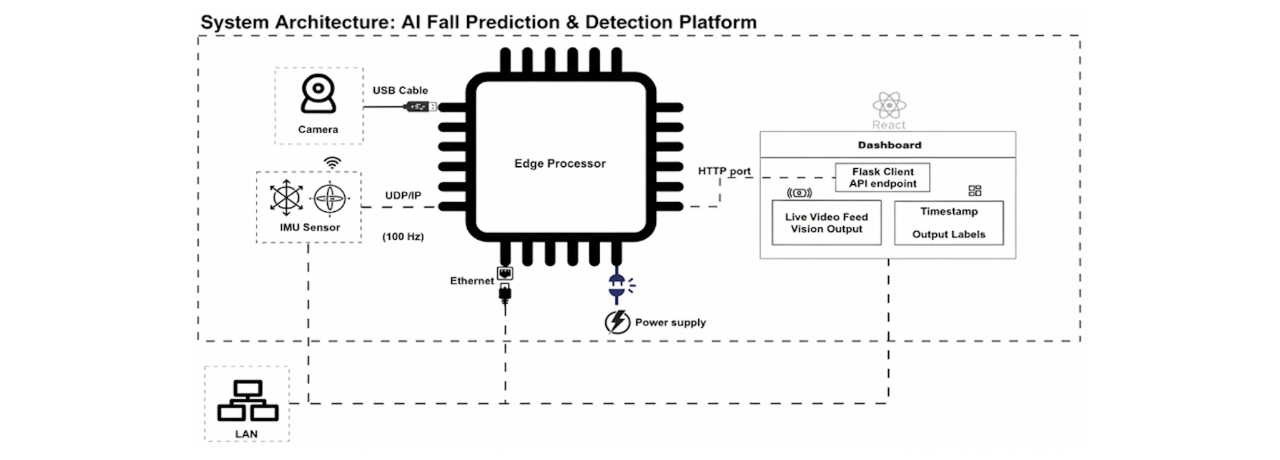
Fig 3. System Architecture
Sensor–Vision Fusion and Edge Deployment
The integration phase presents the most critical evaluation point. Designing fusion logic requires multiple optimization cycles, as synchronizing predictions from distinct modalities (sensor-based and vision-based models) is technically complex. Through iterative refinement, the system achieves high prediction accuracy and low false-positive rates.
Deployment introduces additional constraints. Running inference on cloud infrastructure results in latency and privacy concerns. To resolve this, the system deploys models on an edge device, applying TensorFlow Lite quantization to reduce model footprint and enable real-time performance without persistent internet connectivity.
A monitoring dashboard is developed to display processed video streams and centralized fall alerts, ensuring usability in clinical environments and real-world operations
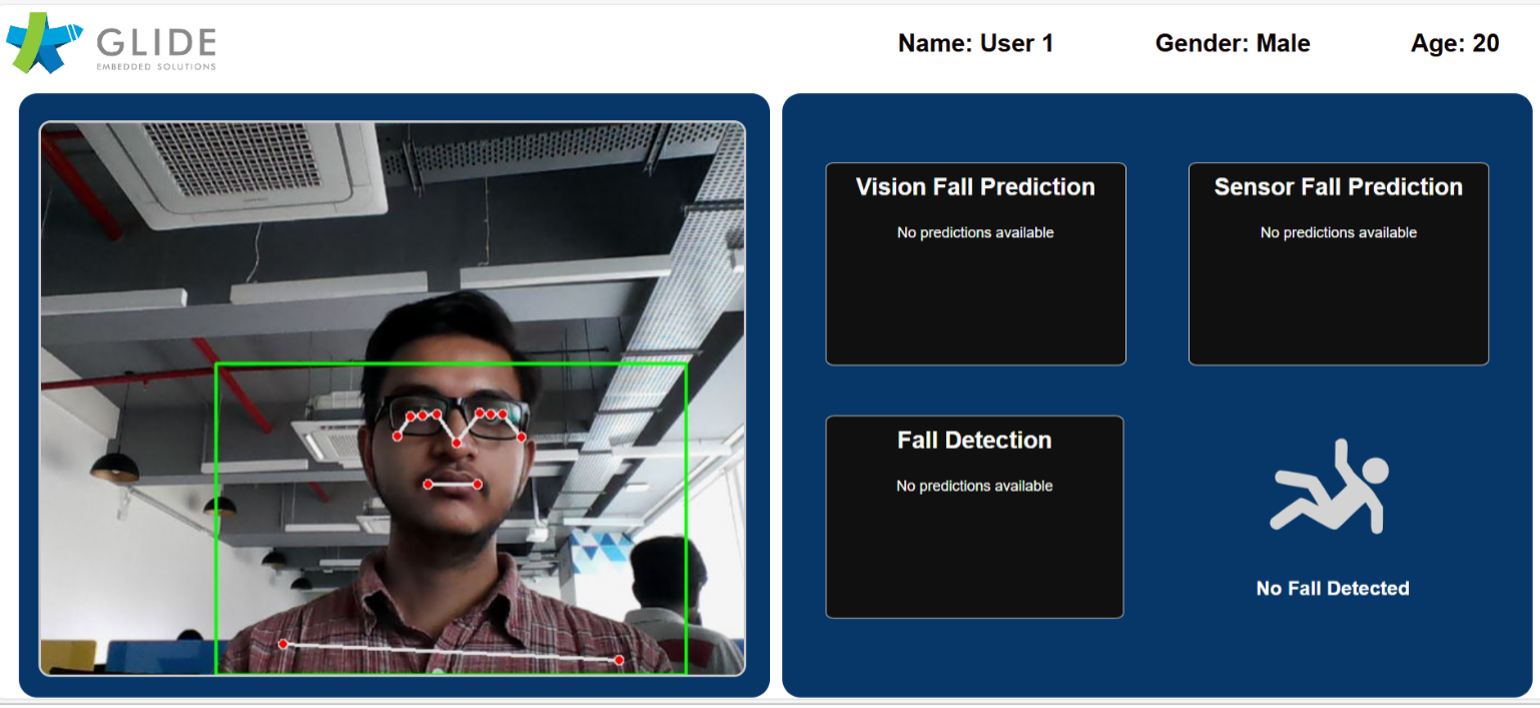
Fig 4. Monitoring Dashboard
Future Applications and Ecosystem Expansion
The system’s potential extends beyond patient monitoring, supporting broader safety-critical environments.
- Wearables: Smartwatches, pendants, or belt clips can integrate our sensor logic. Imagine a fall prediction system that not only alerts caregivers but also triggers a mechanical airbag to cushion the user.
- Healthcare Accessories: Smart shoes or insoles can track balance, while bedside sensors can predict falls during sleep.
- Public Safety: Ceiling-mounted cameras in airports, gyms, or malls could detect accidents in real time. Similarly, factory or warehouse cameras can monitor worker safety.
- Workplace Protection: Helmets or harnesses for construction workers and miners could integrate fall detection sensors for life-saving alerts.
- Rehabilitation & Assistive Robots: Smart mirrors for physiotherapy, assistive robots with fall-prediction capabilities, or ICU rooms with multi-model monitoring.
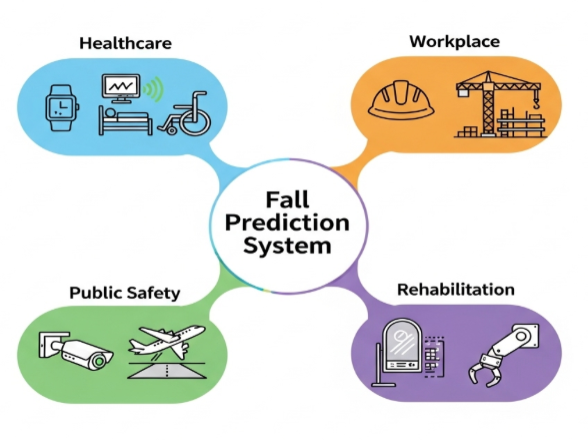
Fig 5. Fall Prediction System
This technology could also benefit high-risk populations, such as athletes, climbers, bikers, or industrial workers, offering them a protective safety net in case of accidents.
Path Forward: Proactive safety in Health care
Fall prediction supports the transition from reactive response to proactive healthcare. Future system enhancements include:
- Assessing post-fall behaviour to prioritize response workflows based on patient condition
- Integrating automated emergency notification systems for instant communication with caregivers and emergency services
- Expanding to outdoor applications using advanced wearable-based frameworks for medical and safety emergencies
By combining vision-based analysis, sensory data, and vital-sign monitoring, the system evolves into a comprehensive safety ecosystem, enabling continuous protection and patient confidence across care environments
Conclusion
The Fall Prediction and Detection System represents a vision for a future where healthcare becomes proactive, not reactive. By combining AI, wearables, and vision, we’re creating solutions that protect the most vulnerable, before tragedy strikes. What once seemed impossible, predicting falls before they occur is now a proven reality.
At Glide Technology, we enable such innovations through our end-to-end Product Engineering Services, covering the entire product lifecycle, from concept research to market-ready solutions across Wearables, IoT, Healthcare, Smart Home, and more. By partnering with us, you can accelerate the development of intelligent, connected systems that not only enhance daily living but also redefine safety and care for the future.
References